The double helical structure of DNA was first published by James Watson and Francis Crick in 1953:
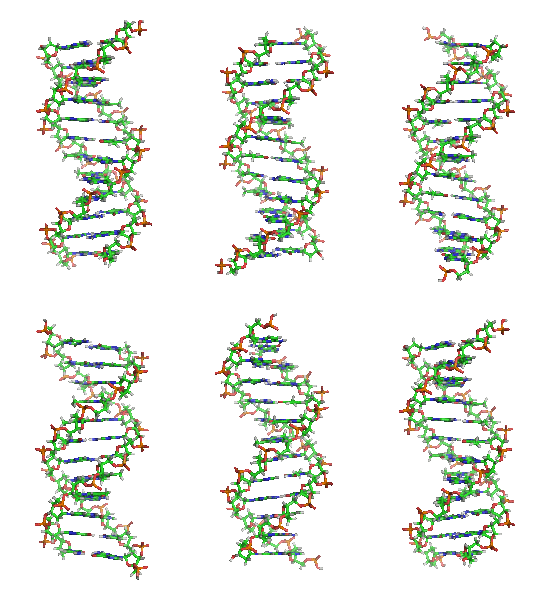
"We wish to suggest a structure for the salt of deoxyribose nucleic acid (D.N.A.). This structure has novel features which are of considerable biological interest."
Novel, indeed, considerable interest, you bet!
Watson saw Linus Pauling's discovery of the alpha-helix as a product of common sense. The trick, he believed, was to rely on the simple laws of structural chemistry and ask which atoms like to sit next to each other.
In the beginning, Watson and Crick assumed DNA molecules contained a large number of nucleotides linearly linked together in a regular way, the difficulty was in imagining how these linear chains could be packed neatly into crystals. They also knew that the DNA molecule had to consist of either two or three polynucleotides, but until more X-ray diffraction data was available, neither option could be ruled out.
Up till that time, only one X-ray photograph of DNA had been published. However, it wasn't very good and much better crystalline photographs laid in the hands of Maurice Wilkins and his assistant, Rosalind Franklin. When Franklin first came to Wilkins' lab, Wilkins was a beginner X-ray photographer and had hoped that Franklin, a trained crystallographer, could help speed up his research. However, the two did not get along and Franklin would not even tell Wilkins her latest results. Getting X-ray photographs from Wilkins and Franklin was next to impossible.
Watson and Crick's initial model of DNA consisted of three chains twisted together such that the sugar-phosphate backbones are in the center and the bases are on the outside. However, they realized that any model placing the sugar-phosphate backbone in the center would force some atoms to come too close to its neighbors.
Then, Watson and Crick began to take notice of biochemist Erwin Chargaff's observation (Chargaff's rules) that the number of adenine (A) molecules was very similar to the number of thymine (T) molecules, and the number number of guanine (G) molecules was very close to the number of cytosine (C) molecules. Another relevant piece of information was the self-replication of genes during cell division. The hypothesis was that gene duplication required the formation of a complementary image whose shape was related to the original surface like a lock to a key. The complementary image would then function as the mold for the synthesis of a new positive image.
After several conversations with theoretical chemist John Griffith, Crick knew that pin-pointing the attractive forces in the DNA that led to its regularity was of paramount importance. Crick suspected that attractive forces between the flat surfaces of the bases might play a role in DNA replication. This sort of forces was something Griffith could calculate and several days later, Griffith told Crick that it was possible that A and T would stick to each other by their flat surfaces and the same goes for G and C.
By this time, Franklin's X-ray pictures were getting prettier and she thought there was evidence that the sugar-phosphate backbone was on the outside of the molecule. More importantly, she had evidence that when DNA molecules were surrounded by a large amount of water, they take on the so called "B"-conformation instead of the "A"-conformation. Upon seeing Wilkins' X-ray picture, Watson instantly recognized the black cross of reflections dominating the picture that could arise only from a helical structure. Time was of the essence.
Watson's improved model of DNA was still fraught with complications, it consisted of a double helix with sugar-phosphate backbone on the outside and like-with-like base paring (A-A, T-T, G-G, C-C). Fortunately, crystallographer Jerry Donohue pointed out that Watson had chosen the wrong tautomeric forms of G and T, they should be in the keto form instead of the enol form.
Eventually, while fiddling with a physical model which was the main working tool of that time, Watson realized that an A-T pair held together by two hydrogen bonds was identical in shape to a G-C pair held together by at least two hydrogen bonds. Chargaff's rules then suddenly stood out as a consequence of a double-helical structure of DNA. Even more exciting, this type of double helix suggested a replication scheme involving complementary pairing and that the backbones of the two chains must run in opposite directions. The final step that was necessary was to verify against X-ray photographs. For this, they turned to Wilkins and Franklin and the double helix was confirmed.
In hindsight, everything has a logical flow and things look easy as bits and pieces of information unravel according to some predetermined course. The difficult part is seeing things from the fuzzy end of the tunnel, and that, can only be experienced.


