May 23, 2008

Bakerzin - Sweet Pleasure


Straight from the horse's mouth...and not in his book!

The Parts:

    Hazel Dacquoise

    1. Hazelnut powder 210g
    2. Icing sugar 230g
    3. Egg white 230g
    4. Sugar 70g
    5. Hazelnut roasted 120g

    6. Whisk egg white and sugar till firm
    7. Fold in icing sugar and hazelnut powder
    8. Fold in chopped roasted hazelnut
    9. Spread onto tray and bake at 200C for about 12~15 minutes


    Praline Feuilletine

    1. Hazelnut praline paste 400g
    2. Valrhona Jivara chocolate 100g
    3. Paillete feuilletine 200g
    4. Butter 40g

    5. Melt butter to clarified butter
    6. Melt chocolate
    7. Add in paillete feuilletine into melted chocolate
    8. Combine the two mixtures and mix well


    (When the dacquoise is baked, spread a equally thick layer of praline over it and chill in fridge until firm.)

    Milk Chocolate Ganache

    1. Valrhona Jivara chocolate 115g
    2. Whipping cream 125g

    3. Boil cream and add into jivara chocolate


    Jivara Chantilly

    1. Valrhona Jivara chocolate 70g
    2. Whipping cream 125g

    3. Whip cream and fold into melted chocolate


Assembly:

Squeeze a thin layer of ganache onto the base board, layer a piece of chocolate wafer on top, squeeze another layer of ganache, place the dacquoise and praline (with praline on top), some more ganache, another chocolate wafer, more ganache, chocolate wafer, a thick dollop of chantilly, then sprinkle a tiny bit of fleur de sel (salt!), chocolate wafer, a hazelnut and voila! Not too buttery, not too sweet and very crunchy!!!

But the real secret is not in the recipe, but the details of the preparation:

How long to whisk? How fast to mix? How long to bake? How fast to shake?

How about temperature? (Ah ha!) What is the temperature of the kitchen? What is the temperature when whisking? What is the temperature to mix in the butter or the chocolate or the frosting? Do you leave the butter in the fridge? Do you leave the eggs outside in the kitchen?

It is all about experience (and the gift!), because every oven works differently and every brand of butter or cream or milk is not the same. It is not really about how long or how fast to whisk, but about the fluffiness of the whites and the consistency of the cream. Neither is it about how long to bake or the temperature to bake, but about the stickiness of the cake when you stick a knife in.

Is it any wonder that stir fry is easy while that tart of yours is just not quite right? And why is that chocolate wafer so crunchy anyway?

Another secret, everything except the fleur de sel and hazelnut on top was created by Pierre Hermes, but that's another delicious story.

p.s. the sweet pleasure in the shop has thicker ganache compared to the one you get at the take away counter, you do get more for that extra 10% service charge.

March 19, 2008

Of Taiwanese, By Taiwanese, For Taiwanese

台灣人說我是新加坡人,新加坡人說我是台灣人,大陸人說我是中國人,我名字明明是江宗翰,可是台灣又偏偏要拼成連我都不會唸的Chiang Tsung-Han,反正我放棄啦,也懶得搞什麼正名運動,隨便大家怎麼叫,別太難聽就好啦!我10歲就來新加坡了,從小學玩到國中,國中混到高中,高中瘋到大學,大學畢業後又莫名奇妙的進了研究所,反正書是讀個沒完沒了,想走又走不了。這一待啊,就在這小小小小的島上待了整整17個年頭,哎。。。哀!!!

目前我在新加坡國立大學讀資訊工程博士(這校名我還算清楚,怎麼去就不知道了),主修好像是那個叫計算生物什麼的,希望,盼望,痴望明年能畢業。平時除了在學校實驗里掃掃地,倒倒垃圾外,喜歡到處覓食,從口味濃郁的印度菜,到注重原味的日本料理,再到奶油多、糖多、巧克力多,三多的甜點,反正毒不死人的我通通吃!吃完了難免會有些罪惡感,所以也會去打打球啦,跳跳舞啦,只要別散了我這身老骨頭,什麼運動都好;因為消耗完了卡洛里,才能肆無忌憚,永續的吃啊。放假時我喜歡去旅行,喜歡去些文化非常不一樣的國家,尤其喜歡那種在異鄉走啊走的,和當地人近距離互動的感覺,所以愛好背包旅行,討厭參加旅行團,不過若是有人贊助旅費,那我是不會太嫌棄旅行團的啦!

台灣人來來去去,有些來新加坡沒幾個月就落跑了,我最近迷上了攝影,準備砸重金買台單眼相機,也打算搞搞網站當博客,邊玩邊照,記錄記錄一群台灣人在這裏的吃喝嫖賭。。。不不不,應該說是豐功偉業,聯絡聯絡過去、現在、未來,曾經踏足在這小小島上的台灣人。所以嘛,誰要是有發現什麼好吃好玩的,或是有什麼麻辣新聞(我敢登,你敢爆嗎?),歡迎踴躍投稿,或提供個網址讓我連連,好東西要和好朋友分享嘛!!!

Taiwanese in Singapore

December 9, 2007

The Double Helix by James D. Watson

We cannot simply look at the world around us and deduce Newton's laws or Darwin's theory of evolution, data on its own does not speak. These discoveries are triumphs of the human mind, abstracted from the world in some magical confluence of deep intuition and deductive reasoning.

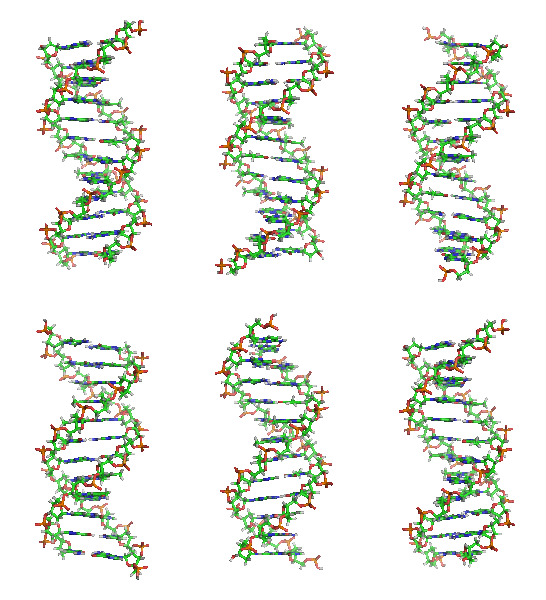
The double helical structure of DNA was first published by James Watson and Francis Crick in 1953:

"We wish to suggest a structure for the salt of deoxyribose nucleic acid (D.N.A.). This structure has novel features which are of considerable biological interest."

Novel, indeed, considerable interest, you bet!

Watson saw Linus Pauling's discovery of the alpha-helix as a product of common sense. The trick, he believed, was to rely on the simple laws of structural chemistry and ask which atoms like to sit next to each other.

In the beginning, Watson and Crick assumed DNA molecules contained a large number of nucleotides linearly linked together in a regular way, the difficulty was in imagining how these linear chains could be packed neatly into crystals. They also knew that the DNA molecule had to consist of either two or three polynucleotides, but until more X-ray diffraction data was available, neither option could be ruled out.

Up till that time, only one X-ray photograph of DNA had been published. However, it wasn't very good and much better crystalline photographs laid in the hands of Maurice Wilkins and his assistant, Rosalind Franklin. When Franklin first came to Wilkins' lab, Wilkins was a beginner X-ray photographer and had hoped that Franklin, a trained crystallographer, could help speed up his research. However, the two did not get along and Franklin would not even tell Wilkins her latest results. Getting X-ray photographs from Wilkins and Franklin was next to impossible.

Watson and Crick's initial model of DNA consisted of three chains twisted together such that the sugar-phosphate backbones are in the center and the bases are on the outside. However, they realized that any model placing the sugar-phosphate backbone in the center would force some atoms to come too close to its neighbors.

Then, Watson and Crick began to take notice of biochemist Erwin Chargaff's observation (Chargaff's rules) that the number of adenine (A) molecules was very similar to the number of thymine (T) molecules, and the number number of guanine (G) molecules was very close to the number of cytosine (C) molecules. Another relevant piece of information was the self-replication of genes during cell division. The hypothesis was that gene duplication required the formation of a complementary image whose shape was related to the original surface like a lock to a key. The complementary image would then function as the mold for the synthesis of a new positive image.

After several conversations with theoretical chemist John Griffith, Crick knew that pin-pointing the attractive forces in the DNA that led to its regularity was of paramount importance. Crick suspected that attractive forces between the flat surfaces of the bases might play a role in DNA replication. This sort of forces was something Griffith could calculate and several days later, Griffith told Crick that it was possible that A and T would stick to each other by their flat surfaces and the same goes for G and C.

By this time, Franklin's X-ray pictures were getting prettier and she thought there was evidence that the sugar-phosphate backbone was on the outside of the molecule. More importantly, she had evidence that when DNA molecules were surrounded by a large amount of water, they take on the so called "B"-conformation instead of the "A"-conformation. Upon seeing Wilkins' X-ray picture, Watson instantly recognized the black cross of reflections dominating the picture that could arise only from a helical structure. Time was of the essence.

Watson's improved model of DNA was still fraught with complications, it consisted of a double helix with sugar-phosphate backbone on the outside and like-with-like base paring (A-A, T-T, G-G, C-C). Fortunately, crystallographer Jerry Donohue pointed out that Watson had chosen the wrong tautomeric forms of G and T, they should be in the keto form instead of the enol form.

Eventually, while fiddling with a physical model which was the main working tool of that time, Watson realized that an A-T pair held together by two hydrogen bonds was identical in shape to a G-C pair held together by at least two hydrogen bonds. Chargaff's rules then suddenly stood out as a consequence of a double-helical structure of DNA. Even more exciting, this type of double helix suggested a replication scheme involving complementary pairing and that the backbones of the two chains must run in opposite directions. The final step that was necessary was to verify against X-ray photographs. For this, they turned to Wilkins and Franklin and the double helix was confirmed.

In hindsight, everything has a logical flow and things look easy as bits and pieces of information unravel according to some predetermined course. The difficult part is seeing things from the fuzzy end of the tunnel, and that, can only be experienced.

December 4, 2007

The lift of the whiff

Never liked any tea other than Oolong, green teas taste too raw, black teas taste too strong, but bergamot works like magic!

Its aroma is longer lasting than floral teas (if you call them teas at all), so two or even three rounds is fine, providing just enough of a lift to make it pleasantly palatable.

Then, of course, there's the Lady Grey (orange, lemon, bergamot)...

November 26, 2007

Fire burn and cauldron bubble

Mutton

Black pepper
Butter (salted)
Ginger
Onions
Rosemary
Shiraz

Baby corns
Bean curd (frozen)
Carrots
Green pepper
Tomatoes

Leafy greens
Udon

One curious thing about Singapore is that the beef/mutton stall in the market is always owned by Indians, at least those that I've come across, in Bishan, Ang Mo Kio, Jurong East, Clementi...etc. Also, there'll be only one beef/mutton stall while 3~4 stalls will be selling chicken, another 3~4 stalls will be selling pork, and those of course, are always owned by Chinese.

November 18, 2007

North Indian thali & dessert

Thali means "platter" and is normally a platter of dishes served together with rice/bread. This particular North Indian thali has (clockwise) yogurt, pickled vegetables, sabzi (some kind of stew), dal (curry beans), paneer korma (curry cheese), roti naan (bread) and papadum (crispy wafer).

On the far plate is dessert, there's a few kinds of barfi (cubes), jalebi (orange fried dough) and gulab jamum (ball in sweet syrup, which actually came with the thali). The bowl of biryani rice on the left came with the thali as well and I also bought a glass of sweet lassi.


Indian food is heavily spiced and mutton can be very nicely done. However, the spices tend to be too overpowering and normally takes the fun out of milder meats like chicken and fish. The breads are chewy and extremely well textured, almost heavenly in the age of polished white bread.

Eating commonly found dessert like the sugary cubes of barfi or the syrupy gulab jamum is like eating dollops of sugar, sweet but uninteresting. They're actually more like candies than full course desserts.

But, best of all, it's only S$12 for EVERYTHING!!!

November 12, 2007

Sticky date pudding infused with butterscotch

Was early for class, decided to check out a new cafe nearby called 25 Degree Celsius.


First, the pudding wasn't the custardy kind of pudding I expected, but that's fine. I see the need to balance the sweetness with fruits, but they could have placed a piece of date on the cake and something more citrus and juicy like orange/tangerine on the side. Good thing there's a scoop of vanilla ice-cream for that extra fluid to blend the butterscotch.

A nice packet of rock sugar, but the coffee's good enough that it doesn't need sugar.